

A River Runs Through Us
A reflection on the seven Sage questions, a webinar and the alchemy of difficult times
There is a particular kind of question that doesn't want an answer. Not immediately, anyway. It wants company. It wants to be carried around for a while, turned over in the pocket like a smooth stone, brought out now and then and held up to whatever light is available.
Our Seven Sage Questions are meant to be those kind
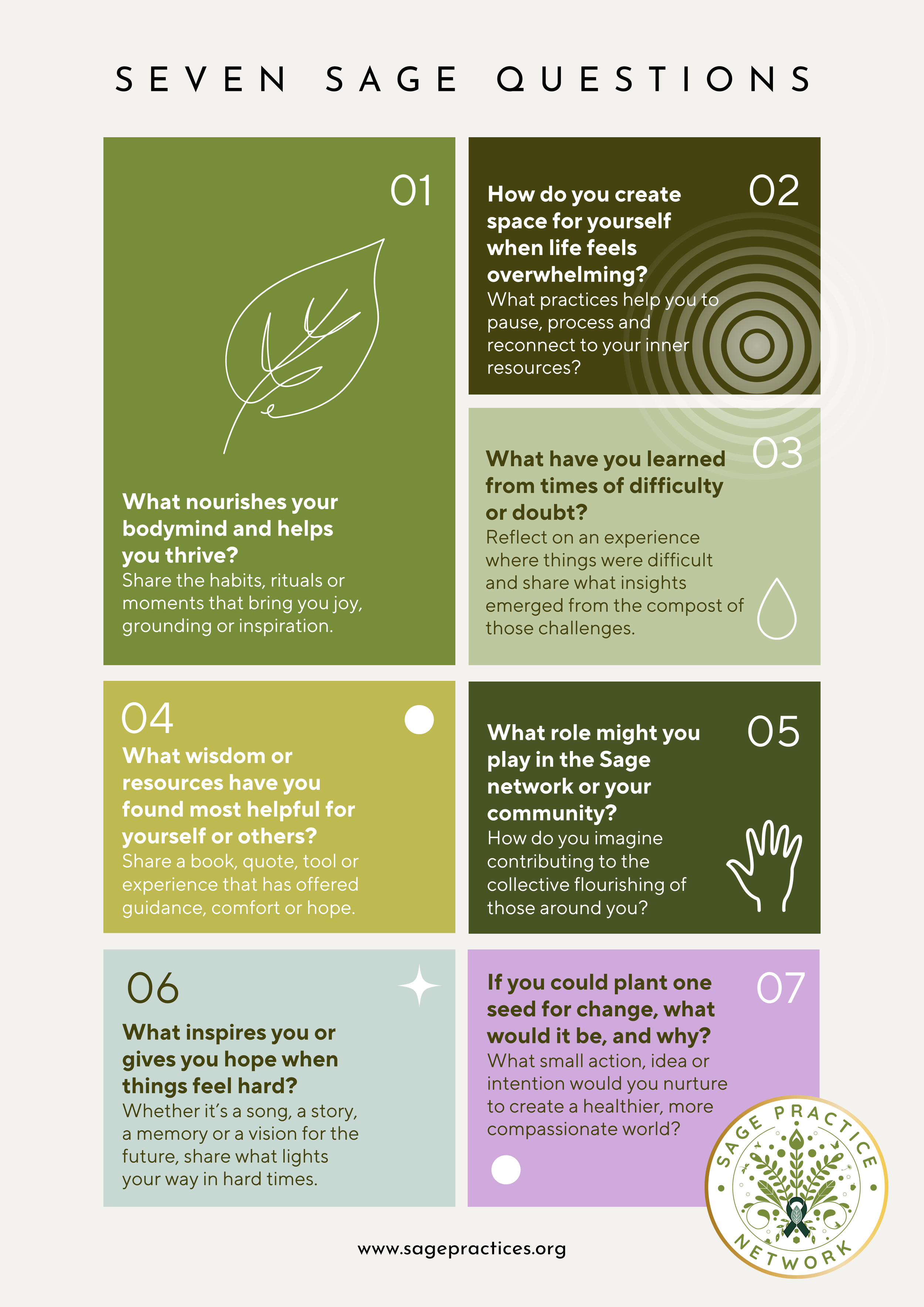
We send them out as part of our introductory gift pack, a small offering, an invitation. Not a questionnaire. Not a form to be completed and returned. More like a set of coordinates for an inner landscape that most of us spend very little time mapping, however long we've been living in it. We live in a fast-paced reactive world after all.
A gathering across time and space
Recently, we were invited by the British Association of Holistic Healthcare to co-host a webinar with Chris Johnstone. It was titled ‘A River Runs Through Us’ and it felt like exactly that. People arrived from different places, spaces, different points on their own journeys. Some knew each other. Some were meeting for the first time across the particular intimacy that a screen, somehow, can create. There is something about gathering online that can strip away the performance of arrival and drop people more directly into the room of themselves. As long as the banks are secure.
We explored two of the seven questions together. Not to find answers. To travel with them. To see what might happen when a room full of people gathered well. Practitioners, thinkers, people who care deeply about how we live and how we heal, taking our time to sit with some questions that most professional spaces would consider too personal, too uncertain, too slow.
What happens and happened, it turns out, is something worth paying attention to.
The questions themselves
The seven questions broadly are:
1. Nourish and Thrive: What truly nourishes you? What helps you thrive?
2. Space: Where and how do you find space - inner and outer?
3. Hard times: What has difficulty taught you? What got you through?
4. Wise resources: What books, practices, people or ideas have been genuine resources for you?
5. Role and Contribution: What is your particular gift? What do you feel called to contribute?
6. Inspiration: What or who has most inspired you, and why?
7. Seed for change: If you could plant one seed for change in the world, what would it be?
They seem simple. They are not simple. They are the kind of questions that reveal different things depending on where you are in your life when you meet them. You could answer them at ten, twenty or sixty and the answers would be different people entirely. Which is rather the point.
“No man ever steps in the same river twice, for it’s not the same river and he’s not the same man.” - Heraclitus
With us in spirit
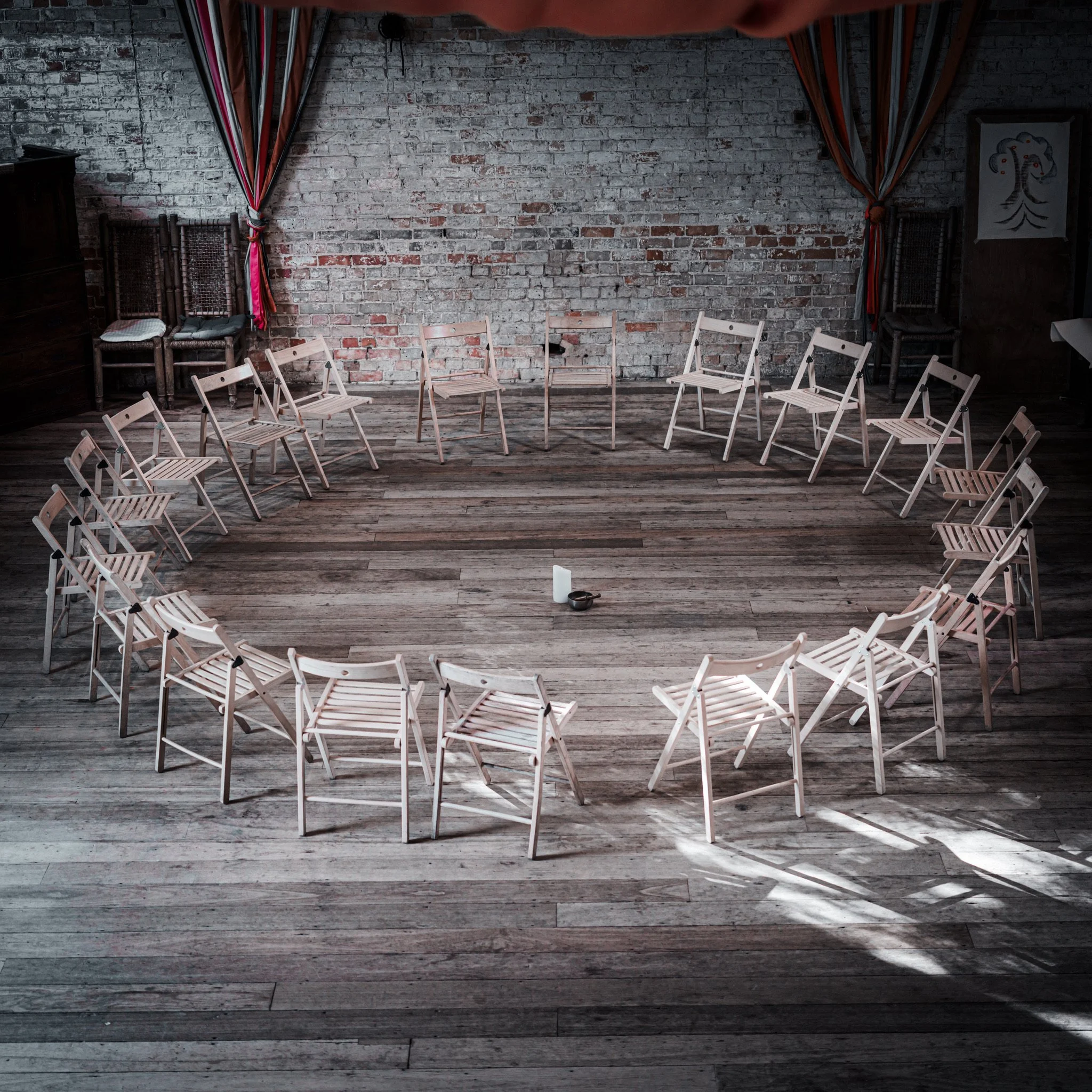
Not everyone who comes to a gathering arrives in the same way. That, we were beginning to learn, is true of online spaces as much as fireside ones. Beforehand there had been the usual quiet fretting - would anyone come, would too many come, would the technology behave, would we? Some people signed up and disappeared. Some couldn’t find the link. Some, no doubt, had every intention of joining but life, as it tends to do, intervened.
And then there are those who arrive differently.
It was like that with this gathering. I’d put a small post on LinkedIn. Dr. Clive Kelly responded. I looked him up and, if I’m honest, felt slightly intimidated. Here was someone who had built things in the world - services, schools, places of refuge, lives of consequence. He seemed, at least to me, far too grand for our small and quietly handmade endeavour.
And yet, in time, an email arrived. Inside were his responses to all seven questions - thoughtful, careful, unguarded - and alongside them, a longer story. Not a story of success exactly, but of what happens when care meets woundedness, when generosity is misunderstood, and when years of darkness must somehow be turned, slowly and painfully, into something that might yet feed new life.
He wasn’t at the webinar. But he was there.
For nourishment, he spoke of five F’s: family, friends, faith (or philosophy), fitness and fun. Simple, he said. And yet everyone's five F's are their own.
His spaces: mindfulness and bodyfulness (bodymindfulness?): being outdoors, moving, climbing, running, kayaking. Poetry. Photography. His wise resources include Forrest Gump: shit happens and life is a box of chocolates, you never know what you might get - alongside Robert Macfarlane's Is a River Alive? His seed for change: active listening. Addressing other people's needs rather than just one's own. Supporting people towards sustainable independence.
And for hard times? He attached a document. He called it simply: The Troubles.
What difficulty teaches
We will not share the details of what he wrote - some things are shared in confidence even when offered openly, and his story is his to tell in his own time and his own way. What we can say is that he described a period of profound and sustained injustice, inflicted in part through the very institutions meant to protect both patients and practitioners. He described years of navigating something that would have broken many people, and did, temporarily, break him and those closest to him.
And then… and this is the thing… he described what he made from it.
A school. A rehabilitation home. A clinical service that has since won national recognition. Reformed protocols at the GMC. Published research. A podcast. A charity website. A community of people supported towards health and understanding who might otherwise have been failed or imprisoned.
None of that exists without enduring ‘the troubles’ he described .
This is not to say that suffering is good, or that we should seek it out, but it is a necessary part of all our lives. It is to say something more careful and more true: that the question ‘what has difficulty taught you?’ is not a question about resilience in the bootstraps sense - the grit-your-teeth-and-carry-on version that has done so much damage to so many caring professionals. It is about courage - in the bearing as much as the daring. It is a question about transmutation. About what becomes possible, sometimes, on the other side of going through it.
The alchemists had a word for it. So, in their way, did the mystics, the poets, the storytellers of every tradition. The thing that breaks you open is sometimes, eventually, the thing that opens you. And the thing which, once survived, will alter your course, not just by what it does to you, but by what it asks of you next.
Circling the questions
What we've found, returning to the Sage questions again and again, in webinars, in retreats, in the quiet of our own reflection, is that they work differently at different depths.
At the surface, they invite stocktaking. A useful pause. An inventory of what sustains you and what you care about. But circle them once, twice, three times, and you begin to go deeper.
Deeper, they invite honesty. The question about hard times, for instance, cannot be answered well from the surface. It requires going somewhere most professional cultures ask us not to go, into the places of genuine difficulty, genuine failure, genuine cost. The places where the competent-helpful-self runs out of road.
Deeper still, they invite something that might be called integration. The bringing together of the parts of ourselves we present and the parts we conceal or do not know. The achievements and the wounds. The certainties and the confusions. The river on the surface and the river underground. And having the courage to allow these waters to mix and merge, forming a deeper current that begins to shape the direction of flow.
This is, we think, where the real medicine is. Not in the answers. In the willingness to keep circling and exploring.
An invitation
We offer the seven questions again here, not as a task but as a companion. Take one. Just one. Carry it for a week. Notice what it stirs up when you're walking, or in the gap between tasks, or in that particular quality of sleeplessness that comes in the early hours when the usual defences are down.
You don't have to answer it in words. You might answer it by noticing what you reach for when things are hard. By paying attention to what genuinely restores you, as opposed to what you tell yourself should. By sitting, just for a moment, with what difficulty has left in you that might - in time, with care - become something of use to others. Most challenges have a potential silver lining, if we have the courage to share our experience. And experience, like knowledge and language, has to be shared to become useful to others.
There is a river running through all of us. Most of us were not taught to listen to it. Most of our institutions were built, quite deliberately, over the top of it.
The questions are a way of making small cracks. Of leaning in close, to the dark and the damp and the deep below.
With thanks to all who gather with us, in person and in spirit.
#sagepractice
#shadowwork
#humanityinhealthcare
#narrativemedicine
#riverofhope
#makingsanctuary
#weavingtogether
The Sage project grew out of the Listening Space - a garden created at the Caversham Group Practice as a way of approaching doctoring differently. If you'd like to receive the seven questions and our introductory gift pack, or to find out more about our work, please get in touch.
Find out more about the work of Dr Clive Kelly, Consultant Physician on Teesside
And about Dr. Chris Johnstone
The Sage Practice Network partners with The British Holistic Healthcare Association (BHHA). The BHHA is in the process of changing its name from BHMA, British Holistic Medical Association to recognise we are all healthcare practitioners should we choose to work towards integration and becoming whole whether that’s by attending to our own health, the health of our communities or the health of the body of the earth from which we have all come and to which we will all return.
Photos Simon Lewis IG @simon.lewis.photographer