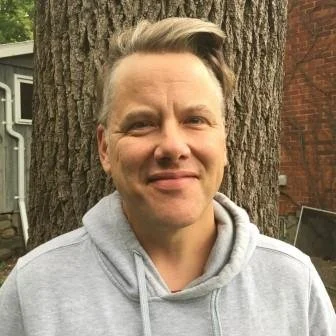
… a despatch from the Kitchen Table
Yesterday evening I shut the kitchen door and walked down the garden to The Hide, the wooden summer house where I’m living at my parents’ home these days. I breathed in the night air and began the quiet work of letting the weekend settle in my body.
I returned from Canada a year and a half ago to be my mum’s carer after a fall left her with a broken cervical vertebra. She is not quite back to her old self, but her recovery has been remarkable - due in no small part to her stoic attitude to life.
Living with my 84- and 89-year-old parents at the age of 55 is not something I imagined for myself, but a series of adventures brought us back together. I help Mum with shopping, appointments and the practicalities of managing several ongoing conditions. Dad is glad to have me around too, because his anxiety about Mum sometimes gets the better of him - especially when he recalls finding her lying unconscious in the kitchen after the fall. I arrived with the remains of my previous life in a suitcase and backpack, an unfinished PhD thesis, and only the faintest idea of what might come next.
The paragraph above stands in for a thousand small negotiations of care, the kind that rarely appear in medical records but shape daily life:
Dad and I, hearts racing, discovering Mum bending down to pick up a KitKat wrapper she had spotted on the floor or finding her lifting a pile of washing in the bathroom, her Zimmer frame forgotten in the kitchen.
Dad exasperated by Mum’s inability to remember anything of last night’s episode of The Night Agent. The television too loud and the subtitles on. The audioscape at mealtimes with two sets of dentures and me with suspected misophonia. They see me going out to meetings, singing in the folk choir and volunteering at my community allotment and think I am overdoing things; I feel I am a social recluse. Mum and Dad aren’t big socialisers but since my cousin and I started playing ukelele together, he has been coming over with my Aunt; the elders chat and us ‘youngsters’ rip out a few folk numbers.
Most days we muddle along together, adjusting to one another’s rhythms and limitations. Care in a household is rarely tidy or efficient; it is something you meet moment by moment. But every now and then the situation moves beyond what we can hold within the walls of the house, and we must step into the wider systems of care.
A few weeks ago, Mum slipped out of bed during the night and couldn't get back in without Dad's help. She seemed well afterwards, but a few days later she mentioned bladder problems, a sore back and seemed more confused than usual. Following a text questionnaire from the surgery, she was prescribed antibiotics without a specimen being taken. The weekend passed and she seemed to improve, but her back pain remained. We returned to the surgery and saw a paramedic practitioner — a diligent, personable man — who doubted it was a urinary infection, attributed the pain to muscle strain from the slip, and prescribed paracetamol with co-codamol at night. As we were leaving, he offered an x-ray. I knew Mum wouldn't want an unnecessary hospital trip, and I was persuaded by his reassurance that it was probably fine to skip it.
A week later the pain hadn't resolved. A duty doctor booked an x-ray for three days later, which revealed a wedge fracture of her L2 vertebra. That afternoon I called the surgery to ask about pain relief. Another duty doctor recommended continuing the current co-codamol dose while monitoring carefully, as increasing it might worsen her postural hypotension.
By Saturday Mum's pain had worsened. She wasn't sleeping and could barely find a comfortable position. Around seven in the evening we called NHS 111. A health advisor worked methodically through a long list of questions. I was glad to answer them, but Mum struggles on the phone and finds complex questioning hard at the best of times. Watching her try to follow the conversation while in pain was difficult for both Dad and me. At the end we were advised to take her to an urgent treatment centre. That didn't seem right: Mum had already been assessed; we knew the diagnosis. What we needed was guidance about pain relief. I said so, and asked whether we might speak to a doctor. I was asked whether I was refusing the advice I'd been given. The question immediately raised the temperature. I said I wasn't refusing help, I was asking whether there might be another way to get it. We were referred to a clinician.
A few hours later the call came. We began again - same story, many of the same questions. The clinician asked Mum to answer some of them directly; Mum, bless her stoicism, did her best through clenched teeth. At the end I assumed we would finally reach a decision about her medication. Instead, she explained she would help us find a "service to access." I paused and asked, perhaps a little too sharply, what the difference was between this call and the previous one. From our living room it felt as if we had simply moved from one script to another, while the decision itself remained somewhere else.
Part of the confusion was the word clinician. To someone inside the system it refers to a range of roles within a process. To someone outside, it carries a simpler meaning: a person with the expertise and authority to make a clinical decision. We were referred onward again.
The next afternoon another call came through. This time I gently interrupted the opening questions and asked one simple thing: whether the caller had the authority to make a decision about Mum's medication. When she confirmed she was a nurse practitioner, I briefly explained the confusion from the night before — she could see only the original referral; the other call had left no trace in the system. After reviewing Mum's situation, she agreed that increasing the co-codamol to 30/500mg, with careful monitoring, was a sensible step. Within minutes we had what we had been seeking the night before.
This is only the most recent story. With more space I could describe Mum's hospitalisation after another fall, when I found myself repeating her history of syncope investigations and bradycardic episodes to each new doctor in turn, asking them to connect with the neurologist who had installed her Reveal device - each clinician making their own fresh judgement, and me stitching her back together from fragments each time. More recently, consultants and surgeons have gone back and forth over whether to treat the basal cell carcinoma on her nose with Mohs surgery or radiotherapy, eventually leaving the family to decide.
Sitting in The Hide this morning with a cup of hot tea and the mist rolling across the garden, I reflect on these encounters with formal healthcare provision. Before going further, I must underline this isn’t a complaint about the NHS or the people within it. Most of our encounters with healthcare providers have been positive. The same paramedic practitioner once treated a pimple on Dad’s back while we chatted about Manchester United’s latest woes. Mum has benefited from six weeks of excellent talk therapy, supported by medication, which lifted her mood considerably. We are fortunate to live in a country where such care is freely available.
But what strikes me is that what we call “healthcare” is not one system but many overlapping stories, each organised by different priorities. Each setting organises attention differently.
At the kitchen table we are a family and notice comfort and mood.
In the clinic we become a case where attention turns to symptoms and risk.
In commissioning meetings we appear as a statistic held between cost and flow.
Sometimes each setting places contradictory demands on us and create what the anthropologist Gregory Bateson described as a “double bind.”
At home I am a son.
In the hospital I am an advocate.
On the phone I am expected to speak the language of protocols.
When different demands from different systems converge in one person, the contradiction becomes embodied.
Sitting at the kitchen table that evening it struck me that no one in this chain had done anything wrong. Each person had followed the logic of their role. The system was trying to match the problem with the appropriate procedure, department, or protocol. But Mum’s situation didn’t live neatly inside those categories. Her pain, her confusion, Dad’s anxiety, the practical realities of our home — all of these belonged to the same story. What the system was trying to match, we at the kitchen table were simply trying to meet.
It was while reflecting on this that another idea came to mind. Gregory’s daughter, the educator Nora Bateson, writes that when systems become entangled in “double binds”, the response cannot simply match the problem from within the same logic. The response must come from another context — with a different tone, different priorities, a different way of paying attention.
In practice this often means that the relational work of meeting the complexity of human flourishing happens not in the clinic but in homes, kitchens, and conversations between people who care about each other.
My story is not unusual. Versions of it are unfolding quietly in millions of kitchens and living rooms. Families improvising around the edges of systems that were never designed to hold the full complexity of human life. Healthcare systems understandably rely on rational structures — protocols, diagnoses, and pathways — to match problems with solutions. But illness and ageing rarely arrive in tidy categories. What I am learning, slowly, is that care often begins where those matches fail. It begins in the small relational spaces where people meet one another’s uncertainty with attention, patience, and improvisation.
For now, we have navigated the morning routine together. I have managed to rise to my own schedule where this blog, my thesis and a world of tasks are calling, dipping in to the slow patterns of parent-time where I’m required. Do I take the co-codamol now? Can you warm up the hot sack? As I write this at the desk in the conservatory, behind me Mum is resting in her dressing gown and Dad is playing classical music. My headphones are on.
The system will continue to do what it can.
And here, at the kitchen table, we will continue to meet what comes.
#sagepractice
#relationshipcentredcare
#slowmedicine
#narrativemedicine
#narrativeecology
Sage Practices Commentary:
Jim's piece stays with us because it's so recognisable. Most of us have stood where he stood: knowing what was needed and watching it get lost somewhere between the living room and the system. What strikes us, reading it through a Sage Practices lens, is how much knowledge was already present at that kitchen table, knowledge of his mother's history, her limits, her pain, what she could and couldn't bear. The system wasn't able to receive it, not because the people in it weren't caring but because it was organised around matching problems to procedures rather than meeting people in their full complexity.
Ivan Illich wrote about this half a century ago: the way professional systems, however well-intentioned, can end up talking over the knowledge that families and communities already carry. We at Sage Practices are interested in that gap: how we might better honour the relational wisdom that already exists, in homes, in neighbourhoods, in the quiet work of people who pay attention because they care.
Jim pushes us further, though, and we think he's right to. Smoothing the border crossing is one thing. But what about the border itself? Healthcare, like education, has gradually organised itself around a particular assumption: that legitimate knowledge lives inside the institution, and that people must travel toward it, leaving the context of their lives at the door. The GP surgery, the urgent treatment centre, the hospital ward, each is a place you go to, where different rules apply and where what you already know counts for less. Jim's parallel with schools and centralised curricula is worth sitting with. What would it mean for healthcare to begin moving in the other direction, toward people, toward homes, toward the knowledge that families accumulate through months and years of paying close attention?
One thing that can help in the meantime, on both sides, is simply knowing what kind of conversation you are entering. When you cross into another country, you don't take it personally that the border guard wants your documents rather than your life story. You learn to have the right things ready. And the best border guards, the ones who've been doing it long enough, have learned to see the person behind the passport. The system needs the passport. The person needs to be seen. Both things are true.
The difficulty comes when neither side realises the other is working from a different set of assumptions. The clinician doesn't know what you've left out. You don't know what they're listening for. A simple mutual orientation before the conversation begins, just an acknowledgement of what each person is bringing and what they most need, won't solve the structural problem Jim describes. But it might reduce the friction that comes from two people, both doing their best, talking just past each other.
And sometimes that small reduction in friction is what allows something more genuinely caring to happen. While we work, slowly, on dissolving the border itself.