

In the Woods
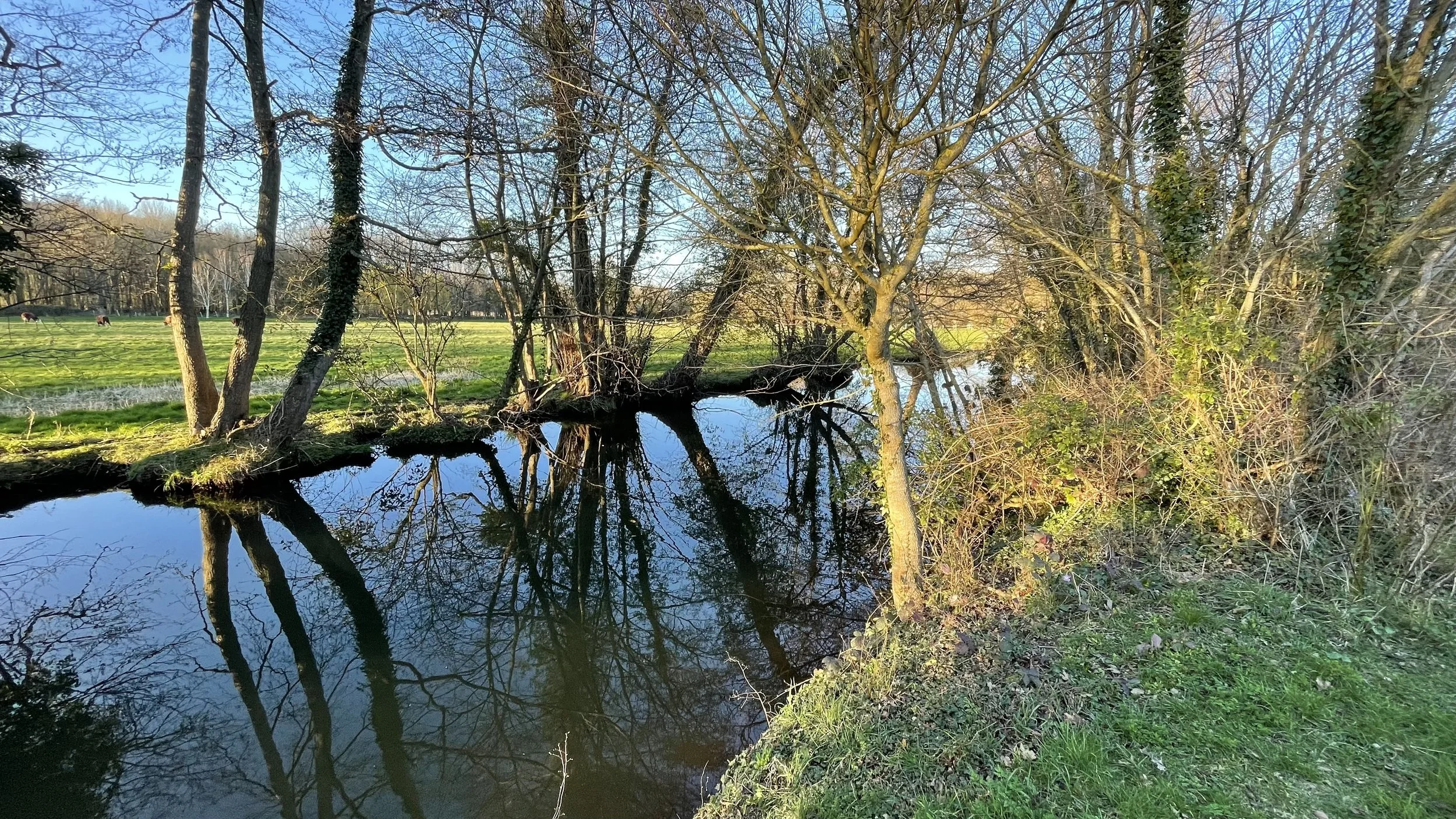
Jessie Teggin and I met several years ago in the Story Garden, Global Generation's meanwhile space nestled between the British Library and the Crick. Introduced by a mutual friend, GG's director, Nicole. We dropped quickly into a shared understanding, talking of a love of gardens and wild places and of the magic that can happen when you tend the conditions for good gathering. When the time came to leave, we discovered we were heading in the same direction, and so we kept walking and talking. We later found we lived only a few streets apart in London, though Jessie also runs the Quadrangle, a retreat centre in Kent. We have been wandering and wondering together ever since.
Yesterday we found ourselves at the edge of the woods, contemplating which way to go. I smile writing this, because our tangible decision mirrored our conversation exactly, both of us in times of uncertainty and change, asking the same questions. Which way to go? What is calling? Do I take the familiar path, follow habit or wait a while and lean into something less known?
Out in the Field grew from a commitment Jessie made during the first Covid lockdown, watching from the quiet of the Quadrangle as healthcare workers bore the weight of the pandemic. What began as a nature recovery programme for NHS staff, designed with Jen Morgan, Liz Murphy and Miriam Saltmarshe, and developed over the years with Dr Jane Stevens, Medical Director for Wellbeing and Workforce at Dartford and Gravesham NHS Trust, has since widened its arms to welcome others across the public sector who are running below empty.
Many NHS and social care workers have now had the chance to breathe out at the Quadrangle, gathering for a day of renewal, restoration and regeneration, breathing in the beautiful natural surroundings: time in the forest garden, by the river, walking in the woods, cooking and eating together. Dr. Ashish Bhatia suggests we might sort our activities into four domains: home, work, play and away. The latter two so often get squeezed out or collapsed into one as our screens pull us from ourselves and our real place in the world, offering passive entertainment or phantom-lands in their place. Time at the Quadrangle - time reconnecting to our first home, to the natural environment - allows a more generative kind of play and away. The kind where you are present, really present, paying attention and noticing. What Joanna Macy calls the Work that reconnects.
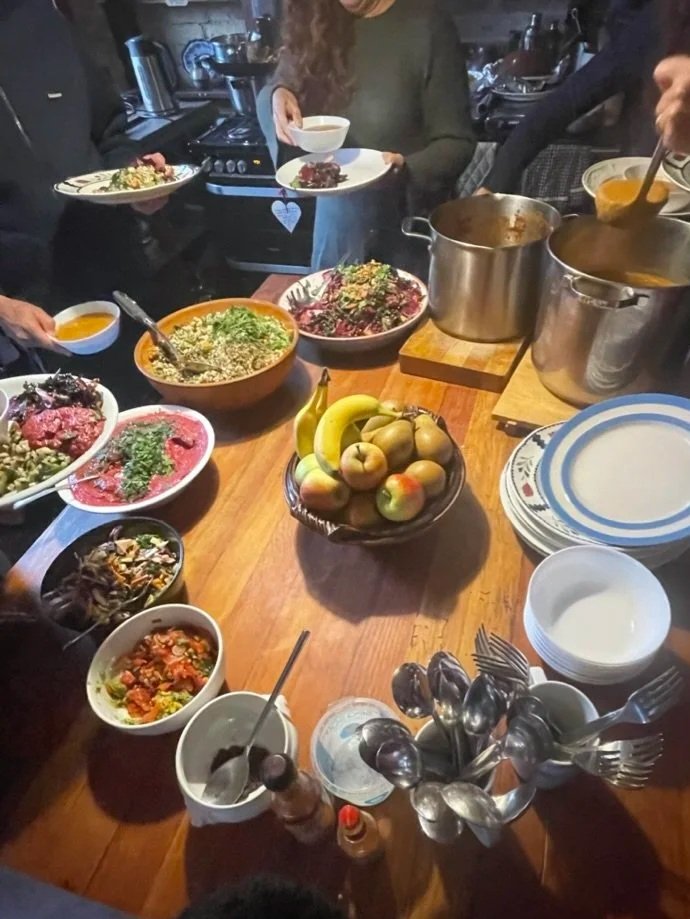
Jessie had just heard that the funding application to continue and deepen the Out in the Fields programme had not been granted. A sign of the times, the NHS belt tightening further, stifling life. Staff wellbeing is topical but peripheral; the machine must go on. We wondered if someone hadn't got the memo: we are not component parts but sentient beings, creatures who wither when stuck in the mechanism and flourish when released from it.
We shared, too, the particular frustration of trying to articulate something that resists words. It is like trying to conjure the atmosphere of a party to someone who wasn't there, or dissecting a joke to find where the funny lives. I had felt this same difficulty recently at the community café at Cook for Good, where I have found a new home since leaving my practice, taken in by the residents of the Priory Green Estate. A former social worker and teacher called Ben had been looking at The CARDS and wanted to talk. He has a fierce intelligence, a hunger for ideas and a frustration with the dominance of systems as they are. As I tried to explain what The CARDS and Sage Practices are really about, I felt it again: the difficulty of clothing something essentially invisible. These are attempts to point at something that dissolves the moment you grip it too tightly.
Ben introduced me to a stream of thinkers who have grappled with exactly this. And walking with Jessie in the woods, I found myself wanting to bring some of them into our conversation, not as an academic detour, but because they help name what we are both reaching for.
The biologist, Ludwig von Bertalanffy, spent his life thinking about living systems, and his central insight feels immediately recognisable: that living things are not defined by their boundaries but by their relationships and flows. A cell isn't its membrane, it is the dynamic exchange happening through and across that membrane. He called these open systems: entities that only maintain themselves by remaining in constant exchange with their environment. The moment exchange stops, the system dies, even if the structure persists. This is why institutions so often become hollow, the structure remains long after the living exchange has left it.
Sage Practices, understood this way, isn't the name or the website or even the network. It is the quality of exchange happening between people, the name is simply the structural membrane that makes exchange possible, not the thing itself. And this, I realise, is what Out in the Field is too and what the Quadrangle holds, and what happens at the kitchen table when someone picks up a card and something shifts. Not a programme, but a quality of encounter. Not an organisation, but an orientation.
This touches something the physicist and philosopher Karen Barad calls agential realism: the idea that things don't pre-exist their interactions but are enacted through them. Sage Practices comes into being each time connection happens, and recedes when it doesn't. It is not a container for connection. It is the connection, temporarily made visible. Like mycelium, which has no centre and no headquarters and only exists in relation to what it is feeding and being fed by. Or like the interstitium, only formally recognised as an organ in 2018, defined entirely by its function of connection and fluid exchange, with no meaning in isolation. These are not just poetic metaphors. They are structurally accurate descriptions of what we are trying to be: infrastructures of relation. Not things that do, but conditions that enable.
The sociologist Zygmunt Bauman wrote about the difference between solid and liquid forms of organising. Most institutions are solid. They have defined edges, membership, hierarchy, permanence. What Jessie and I keep trying to grow, independently and together, is closer to liquid: taking the shape of whatever vessel it is poured into, finding its way through gaps, always in motion. And from complexity theory comes another useful image: the strange attractor, a pattern that a system keeps moving around and through without ever being contained by it. Perhaps Sage Practices, The CARDS, and the Quadrangle, and the Story Garden, and Cook for Good are all strange attractors: sets of values and questions and ways of being that people orbit around, drawn by something they recognise but can't always name.
The paradox we keep living - and that Jessie and I kept circling in the woods - is that the moment you name something, you risk turning a process into a thing. And yet to invite anyone in, you have to point at it, and pointing seems to solidify it. This is not a failure of communication. It is evidence that what we are trying to do is working as intended. The name is the finger pointing at the moon, not the moon itself.
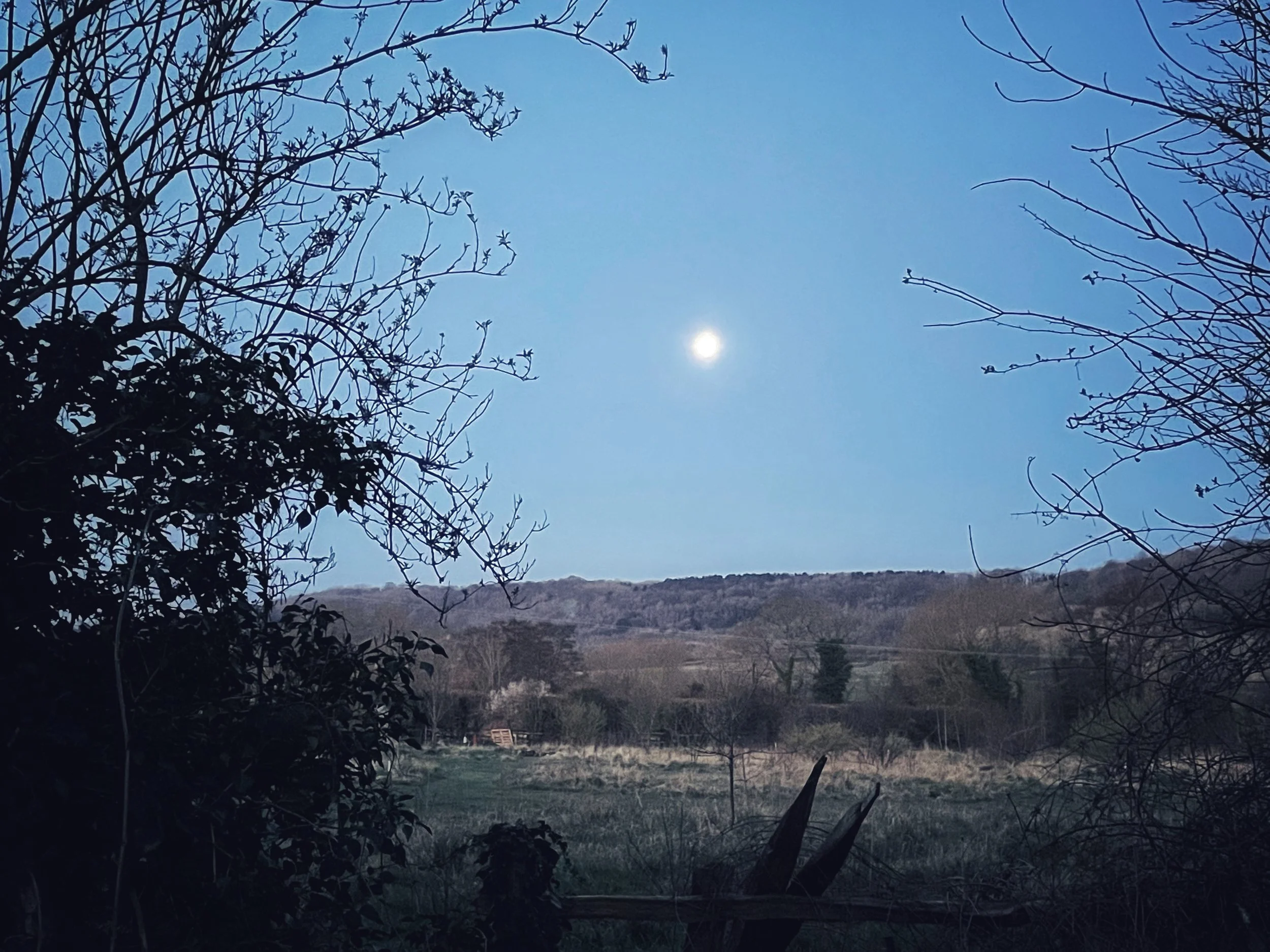
Standing at the edge of the woods, neither of us quite knowing which path to take, we both understood that this not-knowing was not a problem to be solved. It is the condition of being alive to what might emerge. The familiar path had its pull. But something else was calling too - less certain, unmapped and for that reason perhaps worth following.
We didn't resolve which path to take. We took one, as you have to, and the walking did what walking does, which is something different from thinking, and something different again from talking, though it was all three at once. We didn't go into the woods with a question and come out with an answer. It was more like cooking, or like what happens in an ecosystem: separate ingredients, each coherent in itself, meeting in conditions that allow something else to emerge. Not a sum but a transformation. By the time we came out the other side I couldn't say precisely what had changed, only that something had. The questions metabolised rather than solved, exchanged with the trees and the wind and the light falling through branches, given back in a different form. The ecology of being.
What I carried home was less a conclusion than a clearer sense of the questions worth travelling with. And the quiet reassurance of knowing someone else is travelling with them too, finding their own way through, their own version of the same woods.
After saying our farewells, I opened the front door to find a handwritten letter waiting on the mat. A friend had written after a walk we'd taken together on the heath a couple of weeks before. "I just wanted to say how much I enjoyed our recent stroll," he wrote. "I am finding new ways to share some of the mud on the boots of my life - not just new ways, but the first ways to admit that the mud is even there. Seems I'm not the only one with a similar boot situation. Walking and talking with a fellow traveller sure helps."
He ended with a poem. Leonard Cohen, from the Book of Longing:
So I must say it quickly:whoever is in your life -those who harm you,those who help you,those whom you knowand those whom you don't know -let them off the hook,help them off the hook….recognise the hook.
I'm not sure I can add anything to that. Except perhaps this: the letter itself was the thing I had been trying to describe all day. Not a transaction. Not information exchanged. Something more like what happens in the woods, two people walking, the walk changing them both, a gift arriving later, quietly, through the post.
That exchange, I think, is the whole point.
#sagepractice
#relationshipcentredcare
#staffwellbeing
#carefulandkindcare
#narrativeecology
#shadowwork
Watch the beautiful films about some of the Quadrangle’s Projects including Out in the Fields
And find out more about the work of Cook for Good here
Watch this space where we may hear more from Benjamin Ferry and to whom we are grateful for his generosity in sharing his ideas and knowledge as he develops his Living Quantum Praxis: a transdisciplinary framework that challenges the reductionist, linear logic of mainstream mental health, education, and social care. It utilises quantum metaphors- such as superposition, entanglement and the observer effect - not as literal physics, but as precise diagnostic and relational tools to map the messy, layered reality of human experience.