

Stored Sunshine Around a Long Table
Every working Monday, social prescribers and health connectors Jo Lynch and Jackie Tumelty put several dozen potatoes into the oven ready to feed the staff at The Caversham Group Practice.
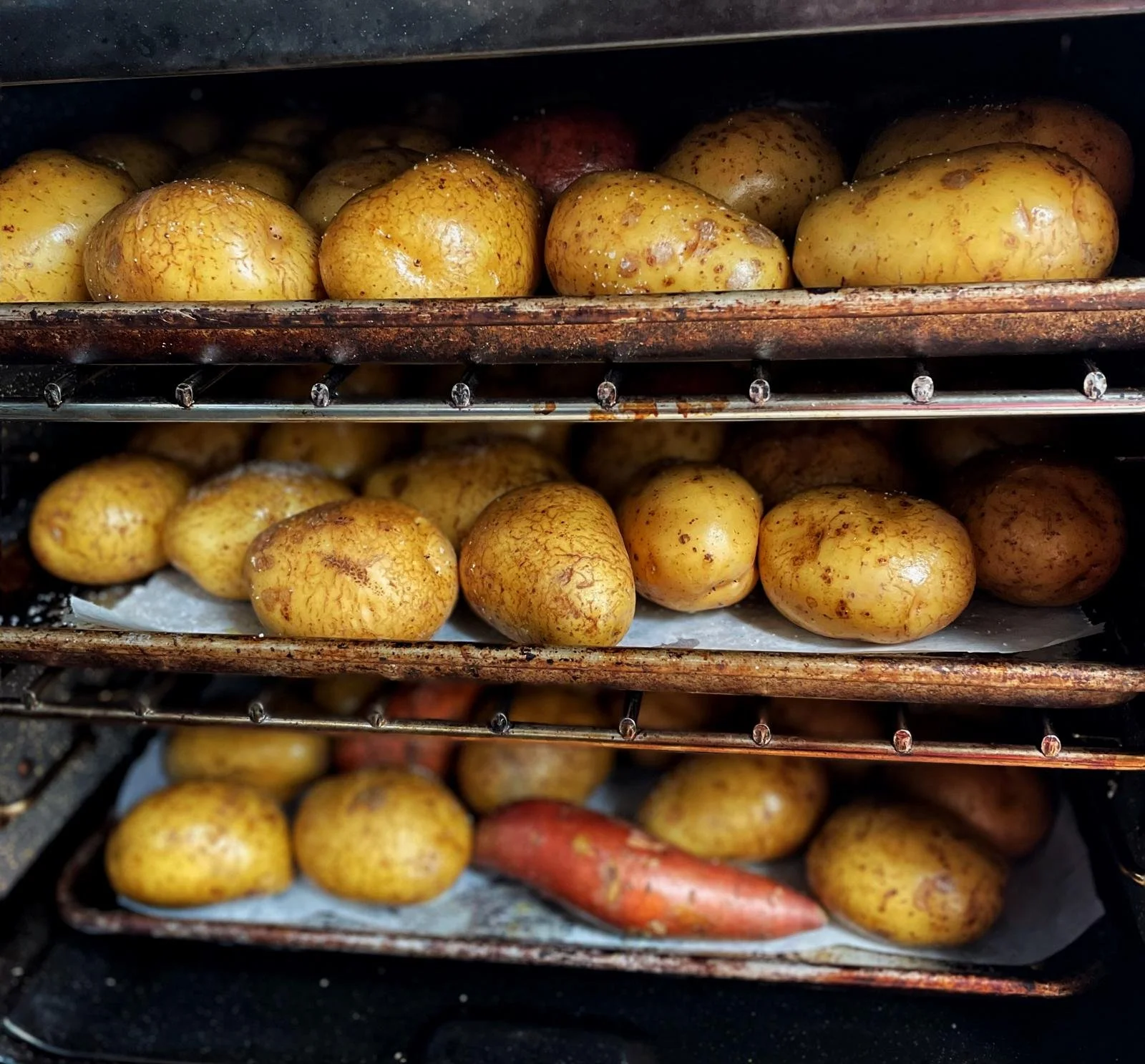
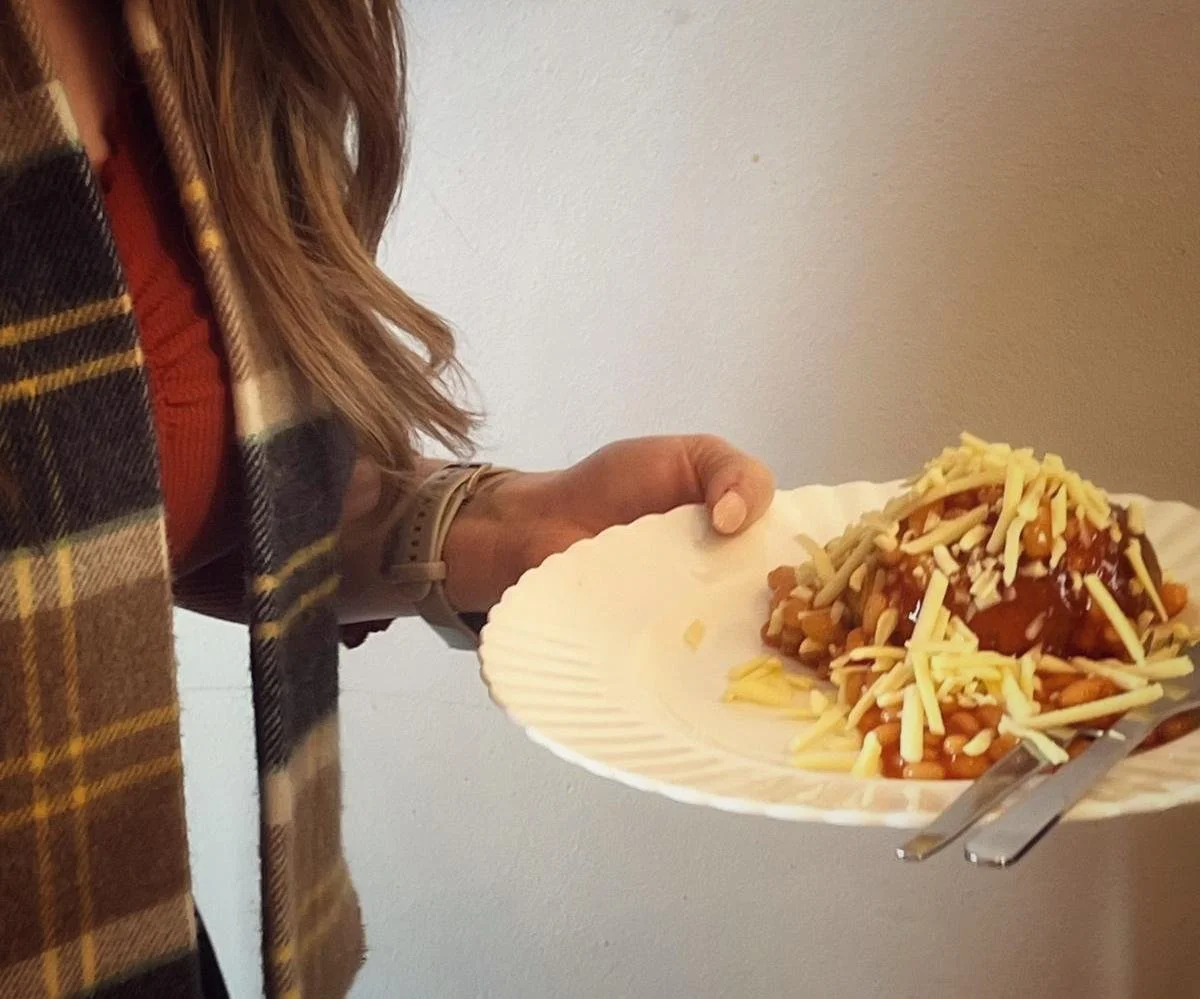
Baked Potato Monday has become a much-loved tradition. It replaced the standard clinical meeting with something quietly radical - an opportunity to pause, breathe out, catch up and eat together. Real nourishment on many levels.
When I worked at the practice, this was the ritual I most looked forward to. It softened the familiar Sunday night back-to-work feeling. I don’t know whether it reduced Monday absenteeism, though I can imagine it might have done. Not that this was ever the motivation.
The Caversham has always been a family-orientated practice, attentive to nurture. In its earlier days, as part of a large health centre with its own canteen, regular staff meals were part of the fabric. There had long been talk of reviving that culture. The pandemic, for all its devastation, created a crack through which something different could grow.
Jo rallied and coordinated teams of volunteers. Young people sent home from university. Patients who had once been chefs, or simply enthusiastic home cooks wanting to support their surgery. Local restaurants and food businesses, forced temporarily to close, donated surplus stock. People emptied cupboards. The cooking began.
Meals were served each lunchtime to all staff. Surplus portions were shared with patients we were speaking to who had little or nothing. It was a response that harnessed the energy to contribute in the face of disruption and funnelled it into practical service. It sustained connection at a time when we were being driven further apart.
Jo remembers growing up, her grandfather, ever hospitable, inviting unexpected guests to stay for dinner with the simple reassurance, “We’ll just put another potato in the stew.” There would always be enough. The practice kitchen carried something of that same spirit.
As business as usual gradually returned and daily shared meals were no longer practicable, the most popular dish in the rotation had already taken root. Baked Potato Monday remained.
Jo tells stories of staff arriving after a bank holiday, crestfallen to discover there would be no potatoes on a Tuesday. Of medical students and visiting clinicians surprised and delighted to be folded into the hospitality. The practice gardening group is included in the feast and, in reciprocity, produce often finds its way into salads or the occasional pudding. We have even seen members of the local community grow in confidence as they begin by helping Jo or Jackie and slowly step more fully into the feeding work.
In writing this piece I wondered about the story and the history of the what we regard as an everyday food. The potato at the centre of our story could be our a grounding metaphor. A humble plant with a delicate flower, quietly performing its alchemy underground - condensing sunlight and storing it in darkness, burying its treasure. What looks ordinary above the soil holds sustenance beneath.
It grows in poor earth, in cold climates, in small plots. It travelled across continents and was once regarded with suspicion - a foreigner, unfamiliar and distrusted, before becoming a daily staple. Its history carries ingenuity and shadow. Early varieties were toxic and had to be freeze-dried on Andean mountains to become edible. Later, in nineteenth-century Ireland, dependence on a single strain left people devastatingly vulnerable to blight. But the catastrophe that followed was not simply botanical. It unfolded within a wider political and economic system in which food continued to be exported while people starved, deepening famine, death and forced migration.
In eighteenth-century France the potato was widely mistrusted. A pharmacist, Antoine-Augustin Parmentier, believed otherwise. Having survived on potatoes while imprisoned during the Seven Years’ War, he became convinced of their value. To persuade a sceptical public, he planted potato fields on the outskirts of Paris and posted guards around them during the day, creating the impression of rarity and worth. At night, the guards were withdrawn and people quietly “stole” the crop, planting it themselves. Suspicion softened. What was foreign became familiar. It is a quiet reminder that minds can change, that sometimes we need not only new evidence, but new stories about worth.
So why write about this? Why does it matter?
Sharing food and breaking bread together is foundational to a good life. In her poem Perhaps the World Ends Here, Joy Harjo writes:
“The world begins at a kitchen table.
No matter what, we must eat to live.”
She goes on to weave the practical and metaphorical significance of the table - how we gather for disputes and celebrations, from birth to death. The table binds us, sacred and profane.
“This table has been a house in the rain, an umbrella in the sun.”
Recently, Radio 4’s Food Programme explored the power of eating together, featuring projects around the world that are harnessing the simple act of gathering at a table. From The Good Kitchen in Sicily to Copenhagen’s Absalon restaurant, and closer to home in Stroud, Brighton and beyond, food activists and creatives are responding to the corporate Big-Food system that offers ever greater abundance of poor-quality food at the same time as food poverty, loneliness and polarisation rise.
A hopeful movement is growing. It recognises the embodied human need to feed and be fed, to nourish and be nourished, to sit side by side and remember our shared strengths and vulnerabilities. In a world where the centripetal forces threaten to uproot and divide us, the table becomes a counterforce: steady, grounding, connective.
I grew up in a household where my father, a refugee from Burma, used food as his means of escape. When he could no longer return home, he travelled there through taste. Cooking was his love language - his way of extending hospitality, of creating intimacy when words were scarce. Through food he offered belonging.
Others are doing similar work at wider scales. In The Sudanese Kitchen, Omer Al Tijani gathers recipes as acts of preservation - holding stories, culture and memory in the face of war and displacement. Food becomes archive. It becomes resistance.
With the rise of cooking shows, social media influencers, it would be easy to think of food as a lifestyle accessory. But it is not this. Food and how we grow, eat and share is the quiet infrastructure of health, culture and planetary survival. And the table is our commons, where we rehearse the kind of society we want to live in.
There is research to support what many of us intuitively know. In Breaking Bread: Investigating the Role of Ethnic Food in Potentiating Outgroup Tolerance, Dr Rodolfo Leyva and colleagues at the University of Birmingham and LMU Munich found that regularly enjoying a wider range of international cuisines was associated with a measurable decrease in perceiving immigrants as cultural and economic threats. Food, it seems, is one of the most accessible and pleasurable ways of encountering difference.
Kevin Morgan, Professor of Governance and Development at Cardiff University and author of Serving the Public, makes an elegant case for aligning public food procurement with health and environmental goals. Schools, hospitals and prisons are not simply service providers - they are food environments. Through their purchasing power they shape agricultural systems, public health and local economies.
When children are well fed they concentrate better, behave more calmly and learn more effectively. Health education ceases to be abstract and becomes embodied in the rhythms of the school day. Hospitals that nourish patients well give parity of esteem to diet alongside drugs, diagnostics and devices. And when prisons provide nutritious food, we are reminded that imprisonment carries a dual purpose - punishment and rehabilitation. Evidence suggests that improving diet can reduce violence and reoffending, signalling that food is not incidental to justice but part of it.
I found this piece difficult to write. There is almost too much to say about food. It sits at the crossroads of health, culture, climate, economics and belonging. Perhaps that is why it is so often made peripheral - treated as lifestyle rather than infrastructure, preference rather than foundation.
And yet nowadays we rarely give food the space and time it deserves. What feels quietly radical about Caversham’s start to the week with a shared meal is its recognition of rest and digestion as essential, not indulgent, an acknowledgement of how important it is to care for the bodies that take care of bodies.
Kevin Morgan makes an important distinction between affordability and cheapness. Good food - appetising, nutritious, culturally appropriate and sustainably produced - should be affordable, but it cannot be cheap. Cheapness often hides its true costs: to soil, to health, to workers and to future generations. Good food requires time, care and decent ingredients.
Perhaps the deeper question is not simply what food costs, but what we value. What do we choose to invest in? And what price do we pay, individually and collectively, when we fail to value good food?
Within a small brown tuber sits adaptation and migration, resilience and risk, monoculture and diversity, nourishment and loss.
And yet when we dig them up there is still childlike delight. Split open, steam rising, butter melting into soft flesh, a baked potato is disarmingly simple.
Perhaps that is enough.
As Joy Harjo reminds us, the world begins at a kitchen table.
On a Monday morning at the Caversham, the oven is turned on. Potatoes are placed side by side. The week will begin again with nourishment.
With huge gratitude to the staff and wider community around the Caversham for the generosity and hospitality which made this place feel like home - Jane
#sagepractice
#londonsage
#sagegarden
#staffwellbeing
#slowmedicine
#relationshipcentredcare
#cookforgood
Further Reading and Resources:
Communal Dining The Food Programme -Part 1
The Absalon project, Copenhagen
The Public Plate (Carly Trisk-Grove's project)
Nourish Scotland project https://www.nourishscotland.org/projects/public-diners/