

Poetry in Motion
From Comrie, GP Alasdair Honeyman, threw a ball into our digital room: “I’m wondering how I might introduce a little more creativity into my appraisal? :-) How many poems would you recommend and what measures would determine if it was a success?” How would we respond to the gentle trickster move in the question? This was an invitation into a dance rather than a real request for a metric. And so the party began. Poems were offered up, reflections fluttered in like the leaves dropping from the trees outside in the storm.
GP Linda Miller, a passionate advocate for healthcare practitioner wellbeing, replied with clarity. “As a senior appraiser,” she said, “I don’t think it’s a question of how many or what anyone else thinks. It’s more a question of which poem has changed your practice.” She spoke of Inua Ellams’s fierce poem F*** Nestlé*, a way of contemplating the commercial pressures on new mums, and of how Lemn Sissay’s writing helped her understand, far more deeply than any safeguarding training, the lifelong impact of the so-called “care” system on children. His memoir My Name Is Why? had been especially powerful for her, resonating with her own experience of having twenty-five foster siblings.
The conversation made me reflect on how often poetry has been a balm in my own primary care work, a swift and surprising route into connection, understanding and integration. Once I had grown enough courage, I began to share poetry prescriptions with patients and they shared them back with me. The effect was powerful. A poem could bridge the space between us, acknowledge experience without intrusion and carry the quiet message: you are not alone.
Art and creativity do that for us. They help us process the strange business of being human. They let us reach across the small but significant divide between one person and another, to articulate something of ourselves, and to invite a response. They ask the questions beneath our questions: What do you make of this strangeness of being alive? How do you carry the suffering, the joy, the bewilderment of it all?
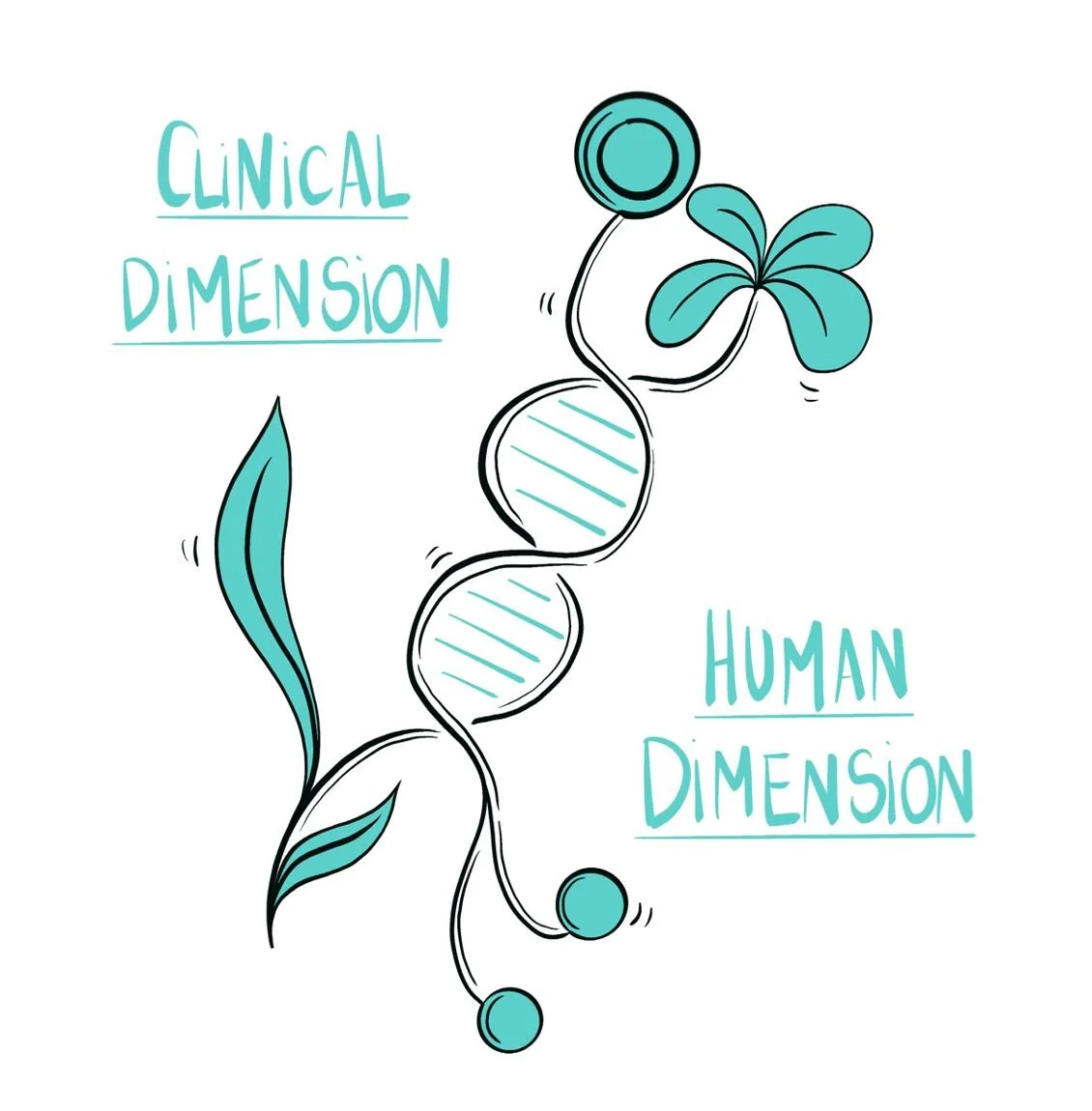
This particular digital conversation took place in a Whatsapp group for the RCGP’s Creative Health Special Interest Group with links to the National Centre for Creative Health and Professor Louise Younie’s Flourishing Spaces work. In an infographic Louise and artist Camille Aubry created, two strands become one medicine: a stethoscope for the clinical work, a plant for the human and alive. Wrapped around each other like a double helix, they form the DNA of care. Ian McGilchrist, in The Master and His Emissary, reminds us how vital this integration is, how much we need an infusion of right-hemispheric wisdom in our increasingly left-hemispheric world.
Our last blog post, written by Simon, explored the risks of AI and made a clarion call to remember our embodied, creaturely selves. Despite the lure and the promise of the algorithm, despite the clever ways chatbots can mimic compassion and tug at our attachment systems, only flesh-and-blood humans are travelling this road of being human. Neuroscientist Rachel Barr, author of How to Make Your Brain Your Best Friend, names our current predicament starkly. She writes:
“The German sociologist Max Weber had a name for it: disenchantment. And we are currently in the late stages of one. Our work no longer feels purposeful, rewards don’t feel rewarding. The system still functions, only none of us feel alive in it.”
She goes on:
“Disenchantment refers to the draining of meaning from systems that once helped us make sense of the world. Its symptoms were first diagnosed after the Enlightenment. The Enlightenment had its factories; we have algorithms. Theirs were powered by steam, ours by stolen data. Both promised liberation but delivered monotony. Both reduced life to what could be measured, optimised or monetised.”
Barr advocates for what she calls a Romantic resurgence (and she doesn’t mean long hair and frilly shirts). She notes that the first Romantics did not stage a revolution. They simply stopped pretending the old logic made sense. Then they went for walks, wrote poems, opened cafés and talked to one another.
I’m also aware of the paradox here. This reflection was sparked by a conversation in a Whatsapp group. I’m writing it on a computer. You are reading it on a screen. We are all threaded into this digital fabric, and part of the work is simply staying awake within it and remembering to step out, to make effort, to take up this great adventure. In a world that can feel devastating, messy and confusing, it is all too easy to lose ourselves in the distractions and false comforts offered by our modern world.
Growing up, I loved the programme Why Don’t You? with its humorous nudge to “turn off your TV set and go out and do something less boring instead.” Now, more than ever, we need to amplify that call through our far more sophisticated machines.
In my first draft of this piece, I ended neatly, pleased to tie up loose ends. The satisfied feeling of restoring order once more. The after-party-tidy-up. I asked Alasdair for his thoughts and permission to post the writing. However, a riddle of a story was sent in return: a reworking of the tale of the Axis Mundi: the world tree with its eagle at the top, serpent at the bottom and the trickster Ratatoska running up and down trading insults, jokes and general disruption.
What could this mean? And then it dawned on me. I laughed at myself and how easily we try to fix and resolve. How instinctively we reach for closure, for a clean narrative, for the sense that we have understood. How hard it is to sit with uncertainty, with mystery and with doubt and difficulty. Being alive is remaining in kaleidoscopic motion, the patterns shifting before we can name them. Edges we cannot smooth; questions that insist on remaining questions.
Perhaps this is part of the re-enchantment, expecting the unexpected, staying in the dance, resisting the urge to categorise, to extract, to reduce what is alive into something manageable. To remember that the maps we create to navigate our world are never the terrain. Primary care has taught me this more than anything. Every day we meet lives that cannot be straightened out or stitched into symmetry. The mud, the mess and the magnificence sitting side by side. The awful and the awesome. A strange, wild, imperfect beauty.
Many craft traditions honour the necessity of this imperfection: a deliberate mistake woven into a rug, beads out of place, misaligned stitches. A reminder that smoothness is not the goal, that the gremlin in the gears may be the thing that keeps us human. The humbling glitches that stop us believing we can perfect the world, or ourselves.
The trickster wanders here, at these edges. Not offering solutions, ‘mestling’ with us, making space for renewal. Tugging at the threads. Whispering that a little mischief may be essential if we are ever to stay awake. That sometimes the poem in an appraisal is not an insight at all but a deliberate disturbance: tearing the fabric through which the wind can blow and ruffle our feathers.
Notes, links and further reading
Alasdair Honeyman is a GP (and much more besides). He works at the Comrie Medical Centre in Perthshire.
Linda Miller is a GP and educator who advocates for creativity and the arts in practitioner wellbeing. More about her workshops, coaching, and writing can be found here. Along with the poetic works referenced above, Linda also suggests taking a look at Roger Robinson’s collection A portable Paradise including Day Moon about the black men’s walking club and read by Roger here
The GP Special Interest Group of the RCGP welcomes GP practice-wide membership from primary healthcare professionals. So, if you are a GP (retired GP), representing a GP practice team, medical student, or clinical practitioner and would be interested in getting involved in this group, please contact NCCH's general manager on info@ncch.org.uk.
And see the GP SIG Network map, which includes great examples of creative health in practice.
Iain McGilchrist’s ideas about the Divided Brain are beautifully captured in this animation
#creativehealth
#staffwellbeing
#slowmedicine
#sagepoetry
#relationshipcentredcare
#narrativemedicine
#AIinmedicine
#shadowwork
#humanityinhealthcare